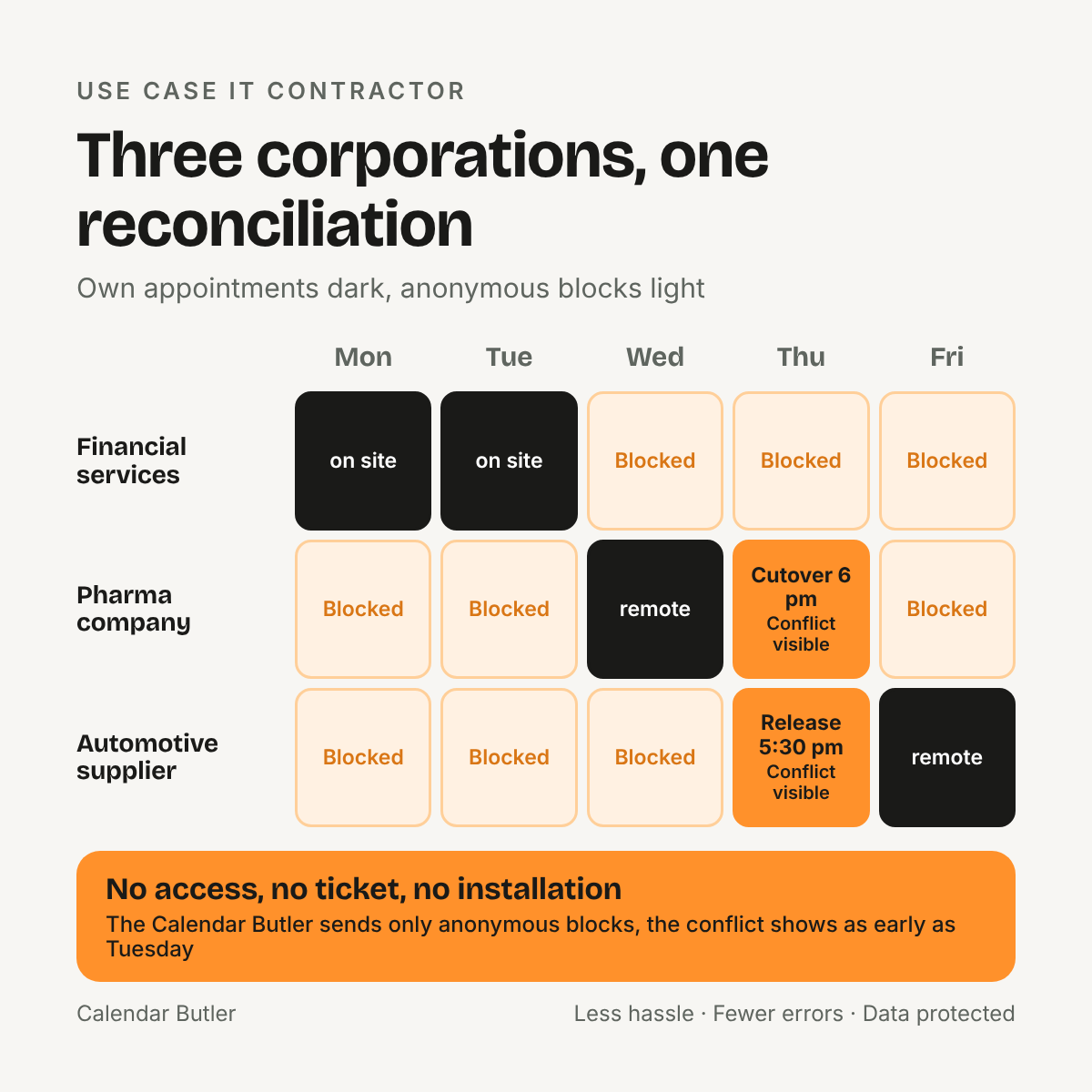
Each of the three corporations has assigned him an account, a calendar of its own and often a laptop of its own, and on none of these devices may additional software run. On top of this comes his own calendar, in which he organizes his self-employment, so that in the end he lives with four calendars that know nothing about one another.
On Tuesday afternoon the pharmaceutical company schedules a cutover for Thursday at 6 pm. At the supplier there is a release approval in the calendar for Thursday at 5:30 pm that a project manager created weeks ago, and because the calendars know nothing about each other, nobody notices the conflict until the contractor is expected in two virtual rooms on Thursday.
Whoever reconciles by hand logs in to three environments one after another for this, often with a second factor and sometimes on a different device, and enters every appointment with a neutral title into the other two calendars. The effort is not small. In our article on maintaining calendars by hand it comes to about 15 minutes per day, which is 55 hours a year, and for a contractor who bills by day rate, each of these hours is time nobody pays for. On top of this come the errors that arise with postponements and cancellations when only some of the copies are updated.
Before talking about tools, it is worth looking at what actually has to be protected here.
The first three points require that nothing from one mandate becomes visible in the calendar of another, the fourth requires that nothing has to be connected in the corporation’s calendar, and the fifth requires that no time is nevertheless booked twice. A calendar that meets all of this needs the start and end of the appointment, but nothing beyond that.
Which appointment takes priority in a conflict is not decided by the Calendar Butler. That follows from contracts, from agreements and from the conversation with both clients, and the Butler makes sure that the conversation can take place in time, because the conflict is visible before it becomes expensive.
Two limits belong here. The Butler can only reconcile what it learns about, and invitations that never reach it produce no block. And whether a corporation accepts invitations from external senders is decided by its mail policy, which is best clarified before the first day of a mandate.
IT mandates often begin at short notice, while onboarding in a corporation can take weeks until account, device and permissions are in place. The Calendar Butler waits for none of it, so the reconciliation can be in place on the first day of a mandate and end on the last day without leftovers.
If you are in a similar situation, you can test the Calendar Butler free of charge for 30 days and check whether it fits your everyday work.
That is the real gain for someone who is at home in three corporations and may change nothing in any of them, because the anonymous block makes your unavailability visible everywhere and nothing else.
 Calendar Butler